Accessibility Tools

Skip to main content
How can we help you?

Community and Living

Community Legacy Grant

In this section

Select a topic to continue

Our Community Legacy Grants are for ambitious and innovative community projects that meet local needs and will create a significant and long-lasting impact.

Since we launched the grants in 2018, we have awarded just over £4million to 31 parish and town councils for 40 community projects across the district. Our investment has enabled communities to build brand new village halls, make major improvements to existing community buildings, create new green spaces and play areas, start a community minibus service and even build a new burial ground and open-air theatre!

Applications for the fifth £1million round of the grants closed on 30 May 2024. For this round, we were particularly looking for applications from parish or town councils where there are significant gaps in key Community Facilities map and applications from parishes that have not previously received a Community Legacy Grant and have experienced high levels of housing growth. 

Our Communities and Funding Advisory Panel is assessing the applications and will make recommendations to our Executive Board about each application. Grant awards will be approved at the Executive Board on 10 July 2024. 

Successful applicants will receive a grant offer letter and a set of terms and conditions, which together constitute their grant agreement. 

The latest round of the grant scheme is financed by the unspent funds from previous rounds of the Community Legacy Grants and our New Homes Bonus scheme, with the remainder from our New Homes Bonus reserve.

We do not currently have any plans to run a sixth round of the Community Legacy Grant scheme.

Contact for more information:
Tracy Perkins – Engagement Officer
This email address is being protected from spambots. You need JavaScript enabled to view it.
01386 565517

  • What are Community Legacy Grants?

    Our Community Legacy Grants are for ambitious and innovative community projects that meet local needs and will create a significant and long-lasting impact.

    Since we launched the grants in 2018, we have awarded just over £4million to 31 parish and town councils for 40 community projects across the district.

    We are now running a fifth round of the grants. The £1million scheme is financed by the unspent funds from previous rounds of the Community Legacy Grants and our New Homes Bonus scheme, with the remainder from our New Homes Bonus reserve.

  • Who can apply?

    The grants are only open to parish and town councils in Wychavon.

    We welcome applications from individual parish or town councils or joint applications from groups of parish and town councils.

    While we will only accept applications from parish and town councils, Community Legacy Grant funded projects may be led or delivered by a community group with the full support of the relevant parish or town council/s.

  • What types of projects can be funded?

    These grants are primarily for ambitious and innovative capital projects (things like buildings, land or other facilities) and will create a significant and lasting community impact. The grants can also provide start-up funding for new smaller, innovative projects that address local needs.

    This time we are taking a more targeted approach than in previous rounds. We will give priority to projects that meet one or more of the three criteria listed below.

    • Applications from parishes that have not previously received a Community Legacy Grant and that have experienced high levels of housing growth.
    • Parishes where there are significant gaps in key community assets. 
    • Ambitious projects that will have a significant and lasting impact on one or more of our strategic goals - particularly health and wellbeing, supporting people most in need, tackling climate change, access to local transport and links between places or improving the natural environment.
  • How much can we apply for?

    Community Legacy Grant awards usually range between £10,000 and £150,000, although we have given a few larger grants for exceptional or high priority projects. As a guide, in this round we would expect most applications to be in the region of £50,000 to £100,000.

    You will need to raise a minimum of 10% of your total project costs (excluding VAT) from non-Wychavon District Council managed sources such as parish/town council contributions, community fundraising or other funding sources.

  • What are the timescales?

    The key dates are listed below.

    8 January: expressions of interest open

    20 February: midday deadline for expressions of interest

    29 February: online briefing for applicants invited to submit a full application

    30 May: midnight deadline for full applications

    July: applicants notified of the outcome of their application

  • How can we apply?

    Each parish and town council can submit one application for this round of Community Legacy Grants.

    There is a two-stage competitive application process. This is explained below.

  • Stage one: expressions of interest

    The purpose of the expression of interest is to provide an overview of your project. This must be made using our online form(opens in a new window) and will include:

    • Parish or town council details
    • A summary of your project and why it is needed
    • Anticipated impact
    • Estimated project costs and how you intend to raise match funding
    • How you plan to engage your local community in the project.

    In your expression of interest you need to provide enough information for us to be able to assess whether your project aligns with the overall aims of the Community Legacy Grant scheme, but you do not need to go into a lot of detail at this stage. 

    The deadline for expressions of interest is midday on 20 February 2024. We aim to respond to expressions of interest within a week of receiving them, so we encourage you to submit your expression of interest ahead of the deadline.

    Submit an expression of interest

  • Stage two: full application

    We will invite parish and town councils whose projects align with the overall aims of the Community Legacy Grant scheme and meet the scheme’s criteria to submit a more detailed, full application. The deadline for full applications is midnight on 30 May 2024.

    We will run an online training session for parish/town invited to submit a stage two application on 29 February at 6.15pm.

    Stage two applications must include:

    • Clear evidence of the need for the project
    • Evidence of community support, including whether or not the local district councillor/s supports the project
    • Evidence of how you have met our consultation requirement
    • A project plan with milestones
    • A project delivery risk assessment
    • Breakdown of project costs
    • Details of match funding, including local contributions
    • Expected impact
    • A completed screening impact assessment covering privacy issues, contribution to Wychavon’s new strategic priorities and equalities impacts.

    You will need to carry out consultation about your proposals before submitting a stage two full application. We have put together these consultation guidelines to assist you in planning your consultation.

  • Scheme rules and eligibility criteria

    Grants must be for capital projects or for start-up funding for new activities or services that meet a clearly evidenced need.   Above all else, there must be evidence that projects are deliverable and will have a positive, long-lasting impact on the community.

    We require applications for new community buildings or significant refurbishments of community buildings to consider installation of renewable energy technologies and those that include car parking facilities to incorporate provision of one or more publicly accessible electric vehicle charging points.  We also encourage applicants to include suitable provision for cyclists.

    We require applicants for projects that include the redevelopment of green space to consider how they could contribute to the provision of new or enhanced habitats for pollinators and other wildlife.

    We will not generally award funding for:

    • Projects that have already been completed or largely completed before we receive an application.
    • Any expenditure incurred or committed before we approve an award.
    • Day to day running costs, replacement equipment, repairs, maintenance or the costs of meeting health and safety requirements.
    • The like for like replacement or refurbishment of kitchens, toilets, floors, roofs or storage in community buildings unless it is part of a larger redevelopment project.
    • One off events.
    • Professional fees for speculative projects or planning application fees.
    • Fundraising activities.
    • Political or religious activities.
    • Work that is the responsibility of other public bodies or organisations.
    • School projects unless the matter is outside any other funding mechanism, and there is a demonstrable wider community benefit, and there is evidence that the community supports use of NHB monies for this purpose.

    Section 6 of the 2019 update of our  New Homes Bonus Protocol (2018-2022) (1.38 MB)  contains the full set of criteria/rules that apply to the Community Legacy Grant scheme. We strongly advise parish and town councils to read these before submitting an expression of interest.  

  • Need help?

    If you have any questions about submitting an application or require more information about the grant application process please email This email address is being protected from spambots. You need JavaScript enabled to view it. or call Tracy on 01386 565517.

    If you need help with developing your project or advice on other funding sources contact one of our communities officers or email This email address is being protected from spambots. You need JavaScript enabled to view it.

    Communities Officers

    South: Evesham and surrounding area
    Ben Price This email address is being protected from spambots. You need JavaScript enabled to view it. 07977 946734 

    Central: Pershore and surrounding area
    Branwen Bingle This email address is being protected from spambots. You need JavaScript enabled to view it. 07977 947144

    North: Droitwich and surrounding area
    Patrick Connelly This email address is being protected from spambots. You need JavaScript enabled to view it. 07977 947143

  • How are grant award decisions made?

    Our Communities and Funding Advisory Panel will assess all full applications and make recommendations to the Executive Board about each application.

    All funding decisions will be made by the Executive Board. This is likely to take place in July.

  • Terms and conditions for all grant awards

    Successful applicants will receive a grant offer letter and a set of terms and conditions, which together constitute their grant agreement. 

  • Will there be future rounds of Community Legacy Grants?

    We do not currently have any plans to run a sixth round of the Community Legacy Grant scheme.
Consultation guidance for Community Legacy Grants

All applicants for a Community Legacy Grant are required to carry out consultation with their communities about their proposals before submitting a stage two full application. 

The level of community support and evidence of need for a project are two of the factors we will consider when assessing applications and making funding decisions.  The outcomes of your consultation can play a significant part in establishing these factors.

These guidelines set out our expectations in relation to community consultation associated with Community Legacy Grant bids and are designed to assist parish and town councils in planning their consultations. These may be of particular interest to parishes or towns applying for a Community Legacy Grant now or in the future. If you would find a virtual Q&A session on planning and running a consultation useful please let us know.

Why consult?

The main purpose of your consultation is to establish whether there is community support for your project.  It will also provide an opportunity to find out how people would like to be involved and to gather views to help shape the development of the project.

If, for example, you are proposing to set up a community shop, as part of the consultation you could ask people how frequently they would use the shop, views about opening hours, what products they would like to see stocked and whether they would be willing to give time to serve in the shop or help in some other way.

You may also want to use the consultation to gather some additional information to demonstrate a need for your project.  Continuing with the community shop example, you could ask people how easily they are able to access a shop at present, how important having a community shop is to them and what benefits they think a shop would bring.

Who to consult?

We would like you to give as many residents and other interested parties as possible the opportunity to give their views on your project.  Whatever the size of your community, we expect you to inform most of them about the consultation.

When planning your consultation think about how you will reach all those individuals and groups that your project may directly or indirectly affect.  In addition to residents it may also be appropriate to seek views from community and voluntary groups, businesses and other organisations based in the locality such as churches, health services or schools.

Think carefully about how to engage with groups who may not typically participate in consultation exercises, for example young people or older, isolated people.

How to consult

One of the most important considerations when planning your consultation is to ensure as many members of your community as possible are made aware of your project and have an opportunity to give their views.

We expect all applicants to try to engage as high a proportion of their communities are possible in their project development and delivery. 

As part of your application you should tell us how many households or residents you have contacted.  There is an expectation that, particularly in smaller communities, applicants will make every effort to reach all households. To maximise your chances of achieving this we expect you to:

  • Use three different communication channels to inform people about your project and invite their views - at least one printed, one digital and one face-to-face.
  • Reach as a high a proportion of the households as possible in your area with printed or directly emailed communications about the project. 
  • Provide people with options for responding both online and offline.
  • Allow a minimum response time of three to four weeks, longer if it includes popular holiday times.

The table below contains some examples of potential communication methods that you may wish to consider when planning your consultation.  These are not exhaustive.

Communication channel

Methods

Printed communication that reaches the majority of households with options for both paper and online responses

  • Hand delivered flyer or postcard
  • Article in village or community newsletter
  • Newspaper article (more relevant to the towns)

Digital promotion with options for both paper and online responses

  • Community Facebook page
  • Community, parish, town or village website
  • Article in e-newsletter
  • Direct email to existing email list
  • Other well used community social media sites

Face-to-face engagement to gather views on the spot.

  • At an existing event or festival
  • Organise a special meeting or event
  • Focus groups
  • Meeting people on the street/at a busy public place
  • Door knocking

What should you ask?

The content of your consultation will depend on your project, what you want to find out and whether it is a new idea or something that has been previously raised, for example through parish or neighbourhood plan consultations.

You may want to develop some structured questions or put together a survey to gather views, or you may wish to simply invite people to tell you what they think.  You could consider using a mix of open and closed questions to elicit a range of quantitative and qualitative views.

  • Open questions allow respondents to answer freely and in their own words. They are useful in finding out people’s thoughts and feelings and for generating new ideas.  However, large amounts of free text can be difficult to analyse so we advise you avoid using too many open questions.
  • Closed questions restrict the respondent to choose their answers from those which are provided.  This includes simple yes/no questions as well as multiple choice questions and questions with scales to rank or rate choices. Care should be taken when developing questions to ensure balance by not leading respondents or by offering a fair set of options to select from.
  • Quantitative methods are designed to measure and generalise behaviours and attitudes and produce data that can be made into usable statistics. 
  • Qualitative consultation provides a deeper understanding of an audience or subject.  It can uncover behaviours, opinions or motivations.

Demonstrating you have consulted

When you complete your full application form for a Community Legacy Grant we will ask you to provide details of your consultation including the methods of communication you used, how many residents were informed about it, a summary of the consultation results and how residents and other interested parties will be involved in developing and delivering your project.

Support and advice

If you have any questions about guidance or need further advice please contact Tracy Perkins via email This email address is being protected from spambots. You need JavaScript enabled to view it. or phone 01386 565517.

document Download Community Legacy Grant consultation guidance (89 KB)

Intelligently Green Awards

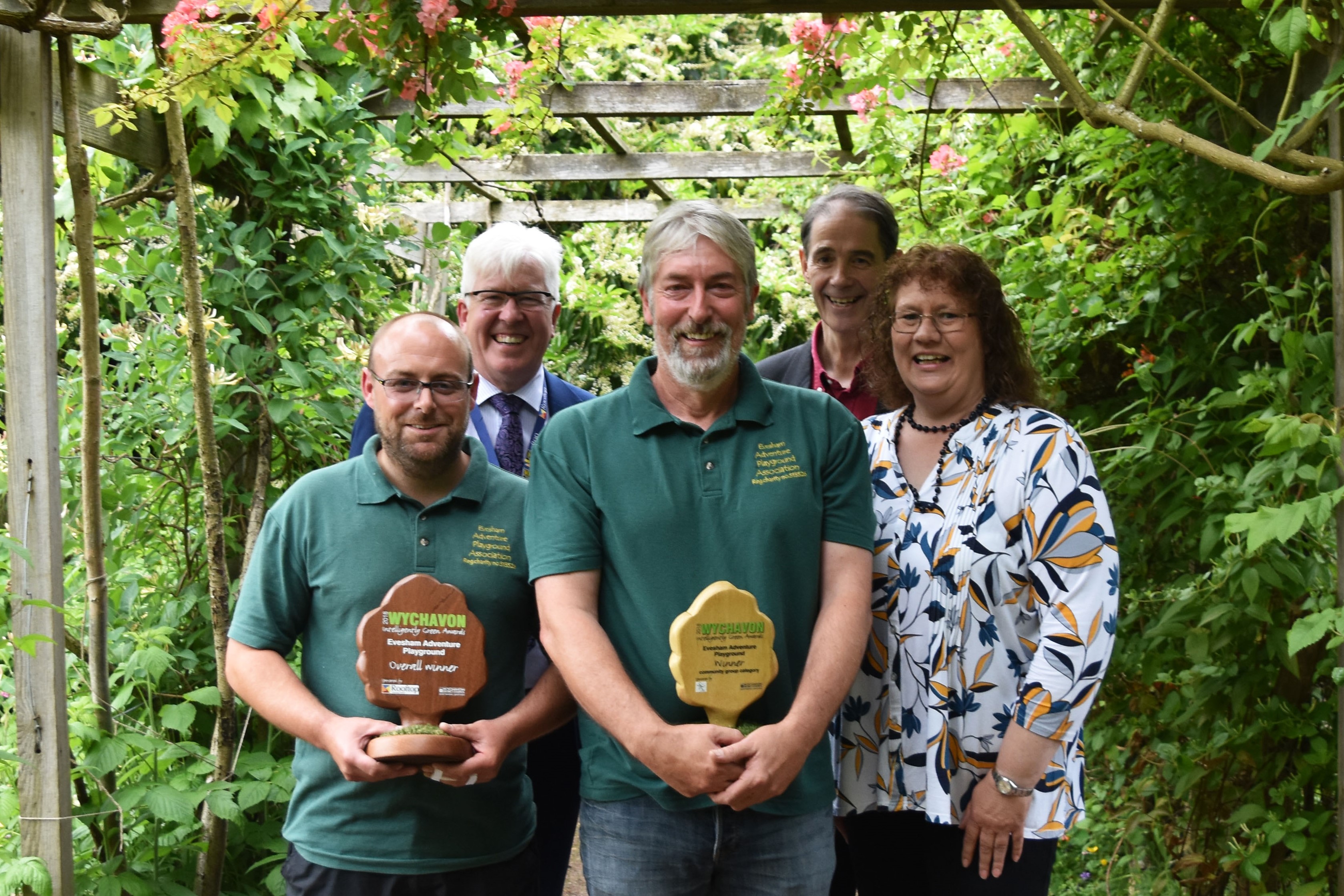
The last Wychavon Intelligently Green Awards was held in 2018, at a special ceremony hosted by leading British environmentalist and writer, Jonathon Porritt, and sponsored by Severn Waste Services.

The finalists gathered at Worcestershire Wildlife Trust, Lower Smite Farm, to see if they were amongst the winners of the awards that recognise, celebrate and promote local green projects, activities and lifestyles that are not only good for the environment but also benefit the community or save money. Nominations from across the district were received in four award categories.

View Worcestershire Wildlife Trust website

The winners

The overall winner of the 2018 Intelligently Green Awards was Evesham Adventure Playground Association for their community pantry, bike schemes and use of reused and reclaimed materials in the adventure playground.

2018 Intelligently Green Awards winners

The other winners:

Individual and household category - sponsored by HERU. View HERU website

  • Chris and Kathy Haynes (joint winner) for their roles in the green refurbishment of Harvington Village Hall, active involvement in Harvington Neighbourhood Plan, Worcestershire Heat Networks project and promoting local food. 
    Watch the video of Chris and Kathy Haynes on YouTube
  • Robin Walker (joint winner) for his active involvement in Transition Evesham Vale, Cyclefest, cycle training for schools and Evesham’s Green Plan. Watch the video of Robin Walker on YouTube

Business and public sector category – sponsored by Walsh Mushrooms. Visit the Walsh Mushrooms website

Community group category – sponsored by Severn Waste Services.

Schools/college and youth group category – sponsored by University of Worcester

  • The DeMontfort School, Evesham for eco-school projects including a plastic reduction campaign and development of outside space. Watch the video from the DeMontfort School on YouTube
  • Ashton under Hill First School received a special commendation for its campaign to promote the use of glass instead of plastic milk bottles in schools.

Other finalists were…

  • John Campbell-Muir – Training the Future
  • Droitwich Salt, Churchfields Saltworks
  • Evesham Methodist Church for their environmental programme
  • Inkberrow Millennium Green Trust for a replacement board walk around a historic moat

All the finalists have demonstrated how they have made a significant contribution to our Intelligently Green theme, and how they are generating community or financial benefits.  The judges were also looking for innovation, creativity and how nominees are promoting greener practices to other people

Other nominees included:

  • Oxton Organics
  • Spot Loggins Ice Cream
  • Welcome to Our Future
  • Brew Bear Coffee House

Sponsors

Rooftop Housing Group were our headline sponsors.  Thank you to all our sponsors

Heat Mapping in Worcestershire

This study looks at heat use across Worcestershire and how natural heat from the earth could be used to meet demand more sustainably across the county especially for growers.

Funded by the Government’s Heat Network Delivery Unit and the Worcestershire Local Enterprise Partnership (WLEP), the report looked at heat use across the county with a particular focus on public sector buildings and large scale business use.

Below are links to the final report into the mapping of heat use in Worcestershire, planning of key sites, and a pre-feasibility study into the potential for geothermal heat in Offenham.

Data sources

You find the following sources of information and intelligence useful:

  • View Census 2011 website - several hundred separate datasets covering a wide range of population characteristics and subject areas.
  • View the Office for National Statistics (ONS) website – datasets for local areas and regions covering a wide range of themes including business and energy, crime and justice, population and transport.
  • View NOMIS website – Nomis is a service provided by the Office for National Statistics giving access to the most detailed and up-to-date UK labour market statistics from official sources.  This includes local area reports that give census information at individual ward, parish and small area level. 
  • View Index of Multiple Deprivation (IMD) - identify the most deprived areas across the country. The indices combine a number of indicators, chosen to cover a range of economic, social and housing issues, into a single deprivation score for each small area in England.
  • View NHS Health Profiles - these provide an overview of health indicators for different localities highlighting issues and how areas compare.
Get in touch

Still can't find what you're looking for?

Contact us for help with services not available online.
Wychavon - Background shape

Wychavon 50th anniversary logo